Saturday, August 24, 2024

Architecture in the Cotswolds: Part 1 - Cheltenham, Hailes, Stanton


This year we finally went to the Cotswolds, after having been told many times that I must go and that would love it, an opportunity finally arose after our wedding this earlier this year. The trip was pretty last minute and so with only 4 days to prepare, I decide to buy the appropriate Pevsner architectural guide; Gloucestershire 1: The Cotswolds, Verry & Brooks, Yale, 2020) from which I'll be quoting, and the corresponding OS map for the area. We chose Winchcombe as it seemed to be in the heart of the Cotswolds and with plenty of good places nearby. Not much about cycling here, suffice to say the Cotswolds looks like a great place for cycling. We saw plenty of older cyclists on the roads who looked like they were having a great time. This journal is mainly an illustrated account of our Pevsner lead once-over of some historic buildings in the north Cotswolds.

It is amazing how much one can actually pack into 3 days. We would like to have had more time to relax but without a car or bike we had to put in a lot of leg work to see these places. I'd say we did pretty well, although anyone reasonably fit could do all of these things. It was actually our honeymoon. We both like walking around looking at old buildings, and so we both had fun. Although there are better places in the UK for nature and wildlife, the Cotswolds stands out for its concentration of architectural gems. It turned out very rewarding to go out of our way to see as many buildings as we could that were mentioned in the Pevsner book. These books are generally very understated in their praise of buildings, if a building is mentioned at all then it is generally worth a look. If it says that something is good then it's probably amazing.

The Cotswolds features buildings from virtually all ages, including bronze age burial sites and Roman villas. Medieval survivals from Anglo-saxon, Norman, early English, Geometric, and of course Perpendicular. Of the gothic styles this is the regions speciality and can be seen in the great churches financed by the wool trade. Superb Tudor and Jacobean designs can be seen in stately homes, mansions and in smaller town houses. Georgian houses, Victorian schools and public buildings. All of these we will see. Modernism hasn't happened here. 

In fact our 3 day trip was so epic that it shall have to be divided into 3 chapters or sagas. I hope that, in this era of quick-fire entertainment, folks will find time to relax and enjoy this journal which may even inform or help to recall your own trips to Cotswolds, either in the past or the future ...

Day 1: Cheltenham, Hailes and Stanton.

Anyone going to Winchcombe may well pass through Cheltenham, home of the famous racecourse. The town has some fair regency architecture and some nice squares and terraces, although we didn't dwell as we wished to escape from the many-legged multitude. Cheltenham minster (parish church of St Mary) is worth a look, even just to see the enormous rose window in the north transept. I'm not yet sure how these kind of windows were made but each panel must weigh an awful lot as they are heavily laced with lead. The church itself dates from at least the 8th century, although this and the other large window were done around 1300, when the Decorated style was used for window tracery. Examples from this period of gothic architecture are less common in the Cotswolds. One thing that's interesting is that the circular design is deliberately slightly off-centre, as if wheeling around. Some rather cute grotesques with dachshund faces, probably c13. Walls and lower stages of tower are c12.


A short walk from Winchcombe is Hailes, site of a former c12 Cistercian abbey. This used to be a thriving and bustling hub of the region, and an important pilgrim site. In 1539 the abbey was demolished for stone. There is still enough of the buildings and some fragments of sculpture to impress the visitor with their  sophistication. At Winchcombe, nothing survives of the Benedictine Abbey, although many stones and carvings were pilfered by locals, who freely helped themselves to the ruins to adorn their houses and farm buildings.


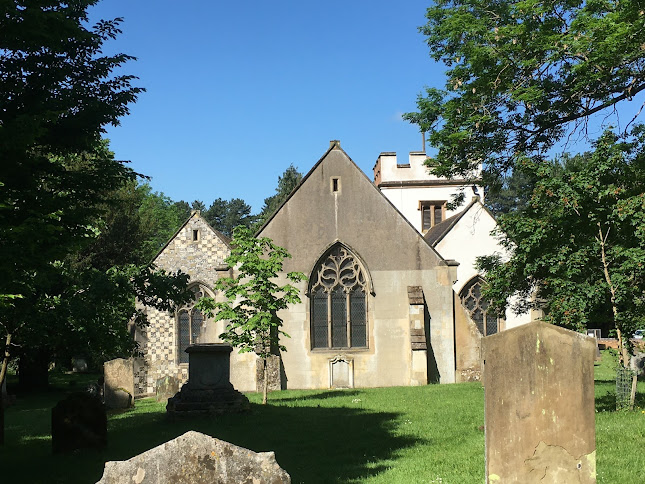
Equally if not more worth a look is the church nearby at Hailes. A miraculous survival, well preserved inside and out. The exterior is modest with c13 trefoil headed windows. On the roof is a c16 timber framed bellcote resembling a small tower, and a sanctus bellicote above the east end of the nave. Reticulated east window early c14. Most remarkable here are wall murals of the 1320s, damaged but carefully restored, showing hunting scenes (dogs cornering a hare), chimeras and some heraldry of the time. Although the church is small, it can be seen from very far away across the fields.


We passed through Didbrook and searched for this cottage. It's a timber framed building with "a fine example of full-cruck construction exposed a one end"; full-cruck being a single beam leaning from the ground to the top of the roof. It was hard to find as largely obscured by apple tree and privet, but worth it.


Passing through the picturesque hamlet of Stanway (more on that in day 3) we passed a cricket pavilion made from larch wood, with thatched roof which was commissioned by the Peter Pan author J. M. Barrie who loved to summer here.


Stanton is described in the book as "one of the most architecturally distinguished of the smaller Cotswold towns". Its preservation is largely thanks to Phillip Stott, an architect from Oldham, who bought the estate 1906 and spent much of his time restoring and improving the village. Old manor farm house, shown below, was built in the early 1600s and has various dates stones. Two large outer gables, four recessed bays in the centre, mullioned windows with mouldings, and diagonal chimneys.


Another house built on a U-shaped plan. Many larger old Cotswold houses are derived from the simple cottage plan of a front door leading to a through corridor with a kitchen on the left and a hall and parlour to the right. The steeped pitched gables are another common feature. All of the houses in Stanton and make use of the golden limestone, which builders had abundant access to in this region. It is the limestone strata that defines the area, and the land around it that cultivated sheep which produced world renowned wool, its economic effects trickling down the local hierarchies. Simple houses and cottages have been rebuilt over the years, using high quality local stone and employing skilled craftsman.


Manor house is one of the larger houses in the village and dates from the c16. "Tudor arched doorway and gothic (Perp) windows. The doorway has Perp mouldings and foliage spandrels, and an added enriched Jacobean lintel." Some very rough quoining on either side of the doorway, and masonry from various ages.

Stanton is fortunate to have its own lighting system, probably the work of Phillip Stott, who worked on pretty much every building around here. He also added a reservoir and "a discreet swimming pool". It would have been good to have seen him tinkering around the village, he must have absolutely loved the place. There are a few of these these quirky little street-lamps (now eco-bulbs) to be found.


The church was closing when we arrived. Perpendicular nave, with an older porch. Two-light window on upper-story with tre-foiled arches, like at Hailes above an older niche with not so old statue. Parapet above with battlement and pinnacles. 


Climb the hill at the end of Stanton's main street to the Mount Inn, a decent pub with extensive drinking terraces. Like many country pubs they close between 2-6pm, which always catches me off guard. However I was not the only one outside waiting for the door to open. From here we had a great view of Gloucestershire with the rooftops of Stanton in the foreground, and a brief moment of rest before the long walk back to Winchcombe.


The god's had been kind. The weather had held out for us and everything had worked out. All and all not a bad first day in the famous Cotswolds, and I feel like I'm finally starting to get my head around what is the Cotswolds after hearing so many people banging on about the place!


Thursday, April 4, 2024

On Biking and boating


Introduction - On Biking and boating

After living on a boat for almost 5 years, I now very much appreciate the comforts of living in a flat. There are many things that we take for granted; hot water on tap, rubbish collection and recycling, the fact that we are not likely to sink or to to be blown adrift. On a boat one has to be more pro-active and this can make life harder. Having to live in lots of different places can make transport difficult, especially if commuting to work, which is where a bike can come in handy. Join me in a reminiscence of the highs and lows of boating and biking, as we travel through the city of London, from the picturesque Colne Valley along the Grand union canal, and up the river Lea via Limehouse to the bleak industrial zone at Ponders End.


Ergonomics and practicalities

Quite early on in our boating life I switched to Schwalbe marathon tyres. Since then I have not had to worry much about punctures. The tyres are re-enforced underneath by a hard plastic shield. This can give one peace of mind when inevitably caught out by occasional sprays of smashed glass on the road or footpath, thus reducing risk of swerving and having an accident. I have only had about 2 slow punctures since I got them almost 5 years ago and they are still going strong. 

No photo description available.

Boring bit

Before I got the Schwalbes I got a puncture whilst attempting to cycle along the rough track from Tottenham to Ponder’s End. This would have been a long commute anyway (having already cycled from Highgate), but the puncture occurred pretty much as soon as I hit the towpath. I then had to walk about 2 miles in the rain at night along past the reservoirs. Central London to Enfield is a bit too far to comfortably cycle on a regular basis, for me anyway.    


Aside note: Ponder’s End was probably the worst of all the places that we stayed on a boat. It’s lifeless atmosphere, poor transport connections, the fact that our barge came adrift in a storm, getting broken into but nothing stolen, the fact that our vessel was boarded and commandeered by pirates (It’s complicated) are not quite compensated for by the single highlight of the area; Wright’s flour mills, whose white weather boarded buildings date back to the 18th century. A remarkable survival and great example of an early industrial factory, set in picturesque grounds.


Be prepared to stray away from the quickest route to where you are going to explore hidden places. Pictured above is Middlesex filter beds, which can be hard to find even if you know where it is, but well worth a detour, and not really on the way to anywhere. Stratford Olympic park is another good one for a bike, and there's always the velodrome if you're into that kind of thing.


If you are thinking of getting a boat, make sure that your bike will fit comfortably through the hatch. Otherwise the stress of having to push or pull it through a tight opening, whilst contorting your body, will add unnecessary wear and tear on your limbs and muscles. There are many boaters who keep their bikes outside their boats but I personally never felt comfortable with that due to to the high levels of theft.


My bike gets serviced at a great little workshop called K's, which is close to where I work. That way I can take it for a service on a morning before work and then pick it up later without waiting around. There’s really nothing like that feeling of riding a newly serviced bike out of the shop. I get it serviced once or twice a year, usually just new chain and breaks. On the river Lea there is a Floating bike shop, ran by a bike enthusiast called Sam, who is a very nice guy and most industrious. A great service if you happen to have your bike near the right part of the river. Mention Human biker for a discount on services. 


Commuting

It has been said that one should vary one’s route to work to avoid complacency and lack of focus. Well, when you have to move location at least 1km every 2 weeks, you certainly need to keep your eye on the road. Regular map checking is a must, at least for the first time round the circuit. I always found it easier to get to work then to get back, as I would often forget where I lived, but my workplace remained the same. 


I invested in some proper cycling clothes, so far all undefined , not because i can afford them but because I like the brand. However they really are not cheap and I’d be happy to learn of other good brands. I am now very much used to wearing cycling clothes when cycling and will only wear normal clothes in exceptional circumstances or for very short commutes.


Highgate is not the easiest place to get to on a bike, as there is no way to avoid an ascent of around 400m. However it is pretty much equidistant from most spots on the boating circuit. Not surprisingly I began to get a more comprehensive perspective of the city then I had done just commuting from the one place. I’m also learning to be more patient with other road users. Expect the worst, and be kind.


Once we get out as far as Greenford, it makes more sense to get public transport. This is a chance for me to read, which I would not usually do at home. I read Evelyn Waugh novels while we were out that way, and am still working my way through his work chronologically. In Oxfam at Lauriston Road near Victoria park I discovered E F Benson’s “Mapp and Lucia”, which become another obsession. Whilst boating and commuting I also got into Fitzgerald for a bit, as well as everyone’s favourite comedy writer; P G Wodehouse. It has to be said that one does not read as well whilst cycling.


The Complete Mapp & LuciaImage result for fizgerald this side of paradiseImage result for waugh handful of dustImage result for wodehouse blandings


Exploring

Perhaps the only thing I now miss now about living on a boat is all of the different places we stayed at. Broadway market is probably the busiest location where we would stay (the sheer volume of pedestrians which stroll along the towpath, many of them gawping shamelessly either into the boat or at you if you are sitting outside, can be quite tiring), and is one of the best places in the East end to buy food. There’s also a good bookshop which always has cool music playing and has many books about things which I know nothing about, set within an elegant Georgian building.


Head straight to Wild Country Organics for the best vegetables. Downland Produce for some nice cuts of meat, or Hook and sons for organic beef and dairy products. For a special treat go to Hill and Szrock, if you can justify spending the extra money then you will not be disappointed. At night the place turns into a restaurant.


Greenford has a nice, rural feel but is spoiled by the smell of a factory that produces foul smelling snacks laced with MSG. Upwind from that the canal and its environ’s have some charm, and Horsenden Hill is definitely worth a climb. Hayes and Harlington is uninspiring for the main part but has some interesting churches within cycling distance, some with very old, carved doorways. One has cat's tongue motif carved into the archway, another has bird heads. A third church had a tramp sleeping in the porch which prevented me from photographing the doorway.


Most notable is the medieval barn at Harmondsworth, the largest of its kind and very well preserved. Heathrow biodiversity area is nearby. Roads around here are nice for cycling. Some quaint villages with a windmill or two.


Uxbridge is as far West as we went, although the Grand union continues all the way to Birmingham. The Colne valley is a great place to explore by bicycle. For a few years environmental activists were camping in the woods trying to prevent or delay the building of the ridiculous HS2 train, which now cuts through the greenbelt. Muntjac deer can be found in the woods. Crowfoot communities grow in the Colne river. A good bike trip from Uxbridge is to Harefield. The medieval church is worth a look. There is some chequered brickwork in the outcalls and some wooden headboards in the graveyard. Told them I’d come and give a talk sometime at the church society, about what I’m not sure. The village has character; some good old houses, a green, a bakery. On the way back to the canal is a large public house called The Old Orchard, with large garden with a spectacular view over the Colne valley.


Most of the places that we explored each deserve a full Human biker article (Please let me know if you are interested in any of them), these include Finsbury, Hackney Wick, De Beauvoir, Kings Cross, Little Venice, Cannonbury, Victoria Park, Hackney Marshes, Springfield park, Stonebridge. All 5 volumes of my Pevsner architectural guide books are pretty well used now. The only one I don’t have is South London, as I rarely go there anymore.


Limehouse deserves a special mention. A rich maritime history gives the place its own identity, distinct in character from most other parts of London. Feels quiet and off the beaten track. St Anne’s, Limehouse is one of Hawksmoor’s 6 London churches. Its pale tower can be seen around Limehouse by day and by night, and its bells chime on the hour. Its facade shows Hawksmoor’s skill at handling classical components which he uses to produce idiosyncratic and theatrical effects.


I came to visit Hawksmoor’s Saint Annes when I first came to London in 2010, because of its connection with the Jack the Ripper, first suggested by Peter Ackroyd and later developed by Alan Moore in his novel From Hell. One of the good things about living on a boat is that you get to dwell in places that you might otherwise only get to visit, and get to know them better. One the other hand, life is nomadic, one never really get’s to know a place, or it people, and fellow boaters rarely move in sync.


Pubs

The Grapes, is one of the finest and one of the oldest pubs in London. If that’s not enough, the owner of the pub is Ian McKellan, who keeps Gandalf’s staff behind the bar and who reads the quiz questions on a Monday night. Outside the Grapes is a sculpture of a herring hull standing on a coiled rope. The fields behind were used for rope making in the past. Some great old warehouses along Narrow street and places to go and look over the Thames and along towards Canary Wharf. 


Only from the balcony of the Grapes can you see Gormley's stylite on the bank of the Thames, while Uberboats whizz by at about 70mph every 10 minutes, creating a wash which erodes all the the structures along the riverbanks. An oil painting in the bar depicts the pub's clientele back in the day.


Another good pub is the Palm tree at Mile End park. It's a good old fashioned East end pub which has free live jazz every weekend. They only take cash. The band invite people up to sing old-timer songs. The landlord serves behind the bar and provides a charming link to the past.


The Anchor and hope is by the River Lea at Springfield. It has the feel of a riverside pub and its layout reminds me a bit of the Free trade inn in Newcastle, on the banks of the river Tyne. They have regular folk music evenings. It tends to get busy in the summer and very quite in the winter. There was a landlord who had the place for 50 years and was a pillar of the local community. Some of the bar staff still remember him.


Cycling on the towpath

I’m sure that many non-boaters and boaters alike are familiar with the joys and disappointments of cycling on the London towpaths. On the river Lea, one can cycle from Limehouse along all the way to the town of Hartford or branch off the Bishop Stortford. It is a pleasant journey although quite repetitive if coming back the same way. Mountain bikes can enjoy the bumpy track more. Some good nature reserves around Fisher’s green, with reports of nightingale a few years ago. Plenty more wildfowl in the ponds, although the bittern proves as elusive as ever. Without getting off the bike you can see common tern, grey heron, mute swan, Canada geese, greylag, mallards, moorhens and the super-aggressive coots.


The towpath can also provide cycling access to Epping forest via Chingford. There's a great descent coming back down out of Epping forest further up at High beech Loughton. Just make sure that your bike is in tip top condition as you can build up a lot of speed here.


Along Regent’s canal, one can cycle from Limehouse as far as the tunnel at Islington, after which the towpath is tricky to pick up again. Progress gets tough around the Broadway market area, where throngs of pedestrians on a weekend press so strong that cycling almost becomes unfeasible. There are many people who jog while listening to music. They can be recognised from afar by their general lack of spacial awareness, clumsy gait, and tendency to hog the middle of the narrow towpath, blissfully unaware of people behind them trying to get past.


I would say that a bell is a must if cycling regularly along the towpath. Although there’s no pleasing everyone. Some folks complain if you don’t ring it and some complain if you do. I recommend the Spurcylce bell for its clean, unspoilt tone that really cuts through. It's hand-made in America and has spawned cheap imitations with manage to sell more units. The sound is quite powerful and can stun people if not used carefully. It's like a simple instrument and you can play with the dynamic to suit different situations. The alan-key fasten mechanism makes it secure against most modern thieves, and at over £50 for the bell one would hope so.


Conclusion - On biking and boating

With the benefit of hindsight I would say that boating and biking indeed are definitely good bedfellows, and some would say inseparable. If you have a boat; you have a bike, full stop, I have been told. For the last few years my Foffa fixed wheel has taken me to work and back pretty much every day, whereas my partner, who refuses to cycle, has had to endure some horrific commutes from places like Springfield and Kensal green which, although blissfully off-the beaten-track, can also be tricky to reach on public transport, with dodgy connections and long walks to boot. Cycling has also helped to keep me fit, as with all of the constant boating chores (moving the boat every 2 weeks, topping up the water every 3 weeks, general maintenance jobs etc) one easily falls out of of any kind of regular gym routine. Cycling can also be used in conjunction with birding, although has obvious limitations.


I always say that there are 5 great things about cycling: 1) it keeps you fit, 2) it doesn't harm the environment, 3) In London cycling is often quicker than public transport 4) it doesn't cost much (after the cost of the bike just about £200 a year for servicing and parts 5) Cycling is enjoyable.


Boating ticks few of the same boxes, although moving the boat can be enjoyable during the right conditions. Being a handy person is a good thing, as every boats has its problems, and the bigger the boat, the bigger the problems. We are so happy now to be on dry land and that the boat that we were responsible for is now someone else's problem!


Sunday, May 24, 2020

Pedestrian guide to Shoreditch


    Out And About In Shoreditch

Many are already familiar with Shoreditch as sort of breeding ground for hipsters and artists, as well as a night out destination for more mainstream city types and Essex crowds. Research for this article was carried out during nationwide “lockdown”, which has provided a great opportunity to observe historic sites and buildings, and has helped me to imagine an older version of Shoreditch. A Shoreditch devoid of motor vehicles, mobile phones, ugly new builds, and all of the trappings of modern life. A time when public buildings were built well and in a way that would stand the test of time. Many gems are hidden in the side streets and back allies away from the main thoroughfares. Here one will find awesome and haunting edifices in the form of old churches, consistently good examples of workshops and warehouses from the Victorian and Edwardian eras, some nice Georgian houses and one or two decent recent developments. These along with myriad boutiques, some great fooderies (still powering through lockdown) and some charming green spaces. After many years of passing through I can now clearly see why it has become a very desirable and fashionable place to live. 

All Fixed Up
One thing which is essential if you are exploring Shoreditch is a hipster fixie bike,  like this…


Its flat terrain makes it a very enjoyable area to explore by bike. Indeed it suits my latest bike the Foffa single speed premium. Being a Dutch brand the Foffa is designed with the flat landscape of Holland in mind. Cycling uphill is a struggle. I had the hub size taken down a couple of cogs after purchase to facilitate this which helped a bit, but it’s much happier on flat ground. Indeed I can see why these kind of bikes are popular in this area and all over Hackney. I have the flip flip hub set to fixed. 

A favourite with cycle couriers, the fixed wheel makes sense. As a cyclist one feels more connected with the bike and short journeys can become easier. With roads in London being usually short and busy (even during lockdown), changing gears is hardly worth while. Hence the fashionable fixie. I have extra breaking power and more control of the bike generally, so the breaks don’t need changing that often. Cycling downhill isn’t as fun but probably a bit less dangerous. I just miss in lazy weather like this being able to cruise around without my legs going. But now that I’m used to riding fixed, riding freewheel feels weirdly out of control and scary, and I’d have to be breaking all the time.


The Brooks bag is super appropriate except for one thing; it doesn't work very well as a bag. I'm scared to put too much in it after I noticed one of the straps had started to come away. Maybe that's my own fault for taking abroad as hand luggage instead of use it for its intended purpose. Ok, its lots of different sections and pockets which I like, but for £170 I just expect a bit more. Nor is it waterproof, like I thought it would be.  I usually use a yellow Ortleib; a much better investment. Its strong enough to carry anything you can stuff into it and is totally waterproof. £80. Foam pads keep the bag off the back which improves ventilation. The interior is cavernous though, so for carrying a Pevsner book and some light refreshments around Shoreditch, the Brooks is fine.

The unusually warm weather of late has given me the feeling that I could be on holiday somewhere, exploring a strange city by bike.  In fact I’m just staying here for a few weeks whilst off work and so have decided to make the most of it. When staying anywhere it is always absolutely imperative that one takes the time to check one’s surroundings and to learn a bit about the history of that place, otherwise we risk missing out big time, like I do, continuously. I owe many of the discoveries and observations here to the Pevsner buildings of England guidebook volume “London 4: North”.

Shakespeare's Shoreditch


In the middle ages was an Augustinian priory west of the high street, known as Holywell. Near this site by Curtain road was built London’s first theatre 1576, where Shakespeare would have performed his plays. Around this time, Hoxton was just one large street and Haggerston was a separate little village. If we walk around these streets today we see no tangible reminder of medieval or Elizabethan times apart from some street names: Holywell Row, Worship street and Curtain Road (Curtain referring to the old curtain wall of the priory).

Streets and Workshops South of Great Eastern Street
There are however one or two places worth a look as they could be easily overlooked (as they were by me on numerous occasions).
Scruton street has a small Italian deli called LA SPIGA worth visiting if hungry. They sell homemade pasta, which is something not to be snuffed at. Next door is a sushi restaurant (currently closed) which looks the business.


At the east end of Worship street: No.s 91-101; a terrace with built in shopfronts with industrial basements designed by Phillip Webb, 1863. Built by a philanthropist to house his workers, and to improve the squalid living conditions in the area. An earlier and more successful social housing project than many to come later. Some nice angles coming of the shop windows, gothic drinking fountain, and eclectic use of Queen Anne windows under gothic arches on 1st floor windows. Without cars its possible to walk around get the feel of a Victorian street, and a pretty stylish one at that. A sandwich shop is still open and construction workers are going there for lunch. 


Some good examples of Victorian workshops can be seen on Phipp Street, Leonard street and around the area. Many were dedicated to the furniture and timber trades. They usually have pilasters or piers unifying 3/4 stories, with large windows between. Many of them still have wall cranes attached to the outside of the buildings. Designed to allow maximum natural light into the rooms, these buildings became occupied by artists and designers and most have now been converted into expensive flats. 


Quiet Time
Between Leonard street and Luke street is the former ST MICHAEL’S church and grounds. These small green spaces, often former church yards, are invaluable to a big city like London, especially for people without gardens who are not allowed to smoke at home. Not for me the big exposed parks where joggers congregate, children run around unchecked and the wind carries the titinitous sound of music played on mobile phones. 


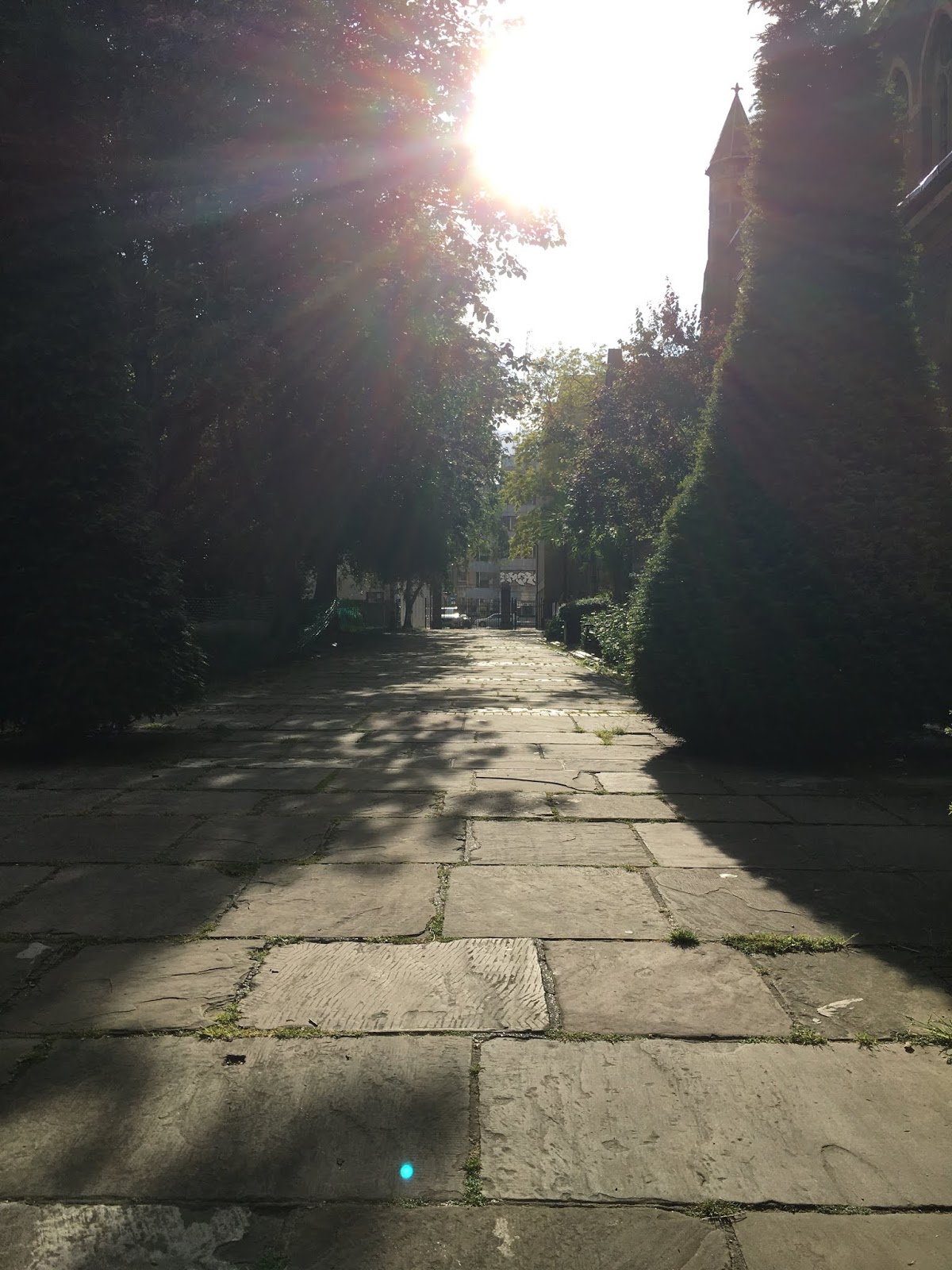
This is probably the best churchyard in Shoreditch for peace and tranquility and in a picturesque setting. The garden is well kept and is under the shadow of the huge Victorian church, built 1863-5. Designed by James Brooks, his first in the area. The church has a tiny steeple with an octagonal turret. Gables have patterned brickwork not seen on his other churches in the area. Adjacent were a group of buildings by the same architect; school, clergy house and hospital, some of which survive. Also seen here everyday is the pied wagtail of Saint Michaels. If you sit still he may come close. There is one bench marked “courier bench” although I haven’t seen the couriers yet.

James Brooks : Church builder
Brooks was commissioned by Haggerston church committee to design 5 churches in the area. 3 of which survive, all easily reachable by bike, and easily recognisable as they are huge and have distinct appearance. His buildings are impressive especially when considering their context and purpose as fairly low budget grand scale projects meant to impress inhabitants of the poor areas. All made from red brick and done in an early gothic style, they stand out from most other churches of the period. Little details repay closer inspections like interesting brickwork, turrets and doorways. 

He was particularly good at composing groups of ancillary buildings around the churches. ST CHAD, 1867-69 has a good vicarage. ST COLUMBA still shows school, clergy house and mission house. This kind of thing was a manifestation of the Victorian vision of the ideal community in which the people are fostered by the church on various levels, and these institutions were attempting to reach out into poor communities. 

As an atheist I always managed ok without Sunday school, yet there is something nice I think about this kind of community spirit. Also as far as churches go, I enjoy them not for what they represent, but for the effect that their forms have on me as a casual observer. I also enjoy noticing little details that might be missed at first glance and for that I usually need some help, usually in the form of a Pevsner book. Architects and craftsman were hired to create works that aimed to transport people above and beyond the ordinary, at a time without cinema or television and mass illiteracy. Sometimes they succeeded.


Saint Leonard & Saint John
Other churches with grounds worth visiting in the area by bike: ST LEONARD’S, by Charles Dance Sen. in 1736-40. On a grand scale comparable with Hawksmoor’s East end churches. Cupola on a tall steeple which rises high (192ft) above the busy cross roads at the junction of Old st, Shoreditch high st, Hackney Rd and Kingsland Rd. Its grounds are impressive but usually busy. Sometimes I will go to one of the hidden seating area behind the rose bushes. Up the road is an expensive French food shop called THE GROCERY where I found this CBD infused beer. It has to said that the shop does sell some outstanding products, especially the baguettes. Since that day though I have only found the non-alcoholic version which was actually going down fine until I noticed.


ST JOHN THE BAPTIST has a good garden also. Another monumental church in the classical style with giant ionic columns on the west front. Again a few too many people for my liking. While I am out and about I am also being careful, keeping my distance and generally trying to avoid others as much as possible. For me this is standard behaviour but now the government has made it easier. South of here on Pitfield Street, some proper fish and chips are being dished out which do not disappoint and are not over priced.


Old Pubs of Shoreditch
On this street are also two good examples of old East end pubs: THE HOP POLE, 1900 with its green glazed-tiled ground floor and baroque detail up above, and THE GEORGE AND VULTURE, rebuilt around the same time. Both feature their name in bold lettering high on the facade as if to attract the weary traveller from afar. My vision of these establishments is probably romanticised. I imagine a cosy fire in winter and lively banter round the bar and round all tables, no music unless people playing, no people sat by themselves on mobile phones, no Sky sports, no gambling machines, no Fosters, just a great atmosphere. Though I love their outward appearance, I’ve been disappointed by going inside traditional looking pubs too many times and so now I always tread with caution and have a good look through the window first.


In the good old days pubs used to be public houses, or inns, where people stayed for a number of days and made themselves at home. Staff would live there, perhaps having their own floor. Locally sourced homemade food would be served as a matter of course without costing an arm and a leg. Imports would be specialities. There probably wouldn’t have been many children in there either. And people would have smoked, a lot. The buildings were designed as pubs and to be clearly recognisable as pubs from the outside, like the red brick Victorian primary schools. Other good examples are THE OLD BLUE LAST, 1876, which curves round the corner of Curtain Road and Great Eastern Street, and is usually a great place to see live music for free, THE CROWN AND SHUTTLE on Shoreditch High Street with ornate facade and stepped gable. THE UNICORN on Hoxton street for its relief of a unicorn, actually just a white horse dressed as unicorn.


Perhaps the best old pub building is YE OLDE AXE on Hackney Road. It has many interesting features such as an octagonal corner turret with clock, tiled first floor and sculpted gable showing the pub name and symbol under a scallop shell. This venue was one of the many now closed East end strip bars.
Hoxton Street


The only pub open at this time during this time is one called HOWL AT THE MOON on Hoxton street. People are queuing 2m apart to buy beer in take away jars which they are then drinking on the street in tightly huddled groups. Many ordinary folk are already starting to completely do away with socially distancing since the Prime minister’s vague statement last week. The other half of the population are locked away indoors scared to venture out for various legitimate reasons. 

But its not the pull of draught beer that compels me to put myself and others at risk, its the homemade burgers which they are serving. With only a trangia stove at home to cook wth, the temptation to buy take away is sometimes too great. The burgers are outstanding. Next door is a charming garden open to the public (though not right now). The clock that stands in the grounds was brought from the old Homerton hospital that was replaced. Further down is the former Hoxton music hall, adding yet more to the area's rich theatrical heritage.


The Expanding Population: Its Effect On Building Types
For Georgian terraces see Hackney Road No.s 237-41 and Christopher Street No.s 15-23. In Hoxton square there is a quirky gothic house at NO. 10. Opposite, across the square, a recreation of a 17th century house, giving an idea of how the square was when originally laid out. Before the furniture trades began to dominate the area in the mid 19th century, Shoreditch was a home of wealthy merchant types. By 1750 there were 2,500 houses here and 10,000 citizens. The population had grown to over 100,000 by 1850. 


In Hoxton square a lyrical sculpture of a juggler celebrating the circus training centre north of the square, in a former electricity station. At Charles Square, a good house of 1727, made of red brick and with a carved doorway. Around it are typical post war flats. Victorian Shoreditch had many slum areas, all eventually cleared away and replaced by public housing. One of the best intentioned examples of early housing schemes are On the east side of the street and in Goldsmiths square, built 1894 with red and yellow brick bands on the gables. They're nothing to blow anyone away but compare them, if you will, with the surrounding post-war flats built by the same council. Perhaps the most oppressive mass housing solutions are the two towers north and south of St Chads in Haggerston called FELLOWS COURT. The north one towers over a bleak shopping area with a cheerful little community centre which runs music classes. 

Goldfinger

Nearby is a more successful venture in modernism; HAGGERSTON SCHOOL by Erno Goldfinger, 1962-7. This architect was the inspiration for the bond villain and was a neighbour of Bond author Ian Flemming on Willow Road, Hampstead. Here he is said to have raised the bar for most secondary schools of the date. Subtle details reward closer inspection; windows which either wrap around the side of the building, monumental gutters, elegant spiral staircases, decentralised plan. Even smaller buildings are well proportioned with some nice features.

Street Art Shrine


Not far from here is a good place place to see a particular sub-genre of street art, transient in its nature, and an important part of the urban fabric. On a little lane called Diss street just off Hackney road. A little urban space has become a sort of shrine to street art. What its about I cannot say, only that I like it.


These observations have been compiled over numerous mini visits and explorations over a few weeks. Its far from an exhaustive account. With one more week to go here I feel I’m hardly even scratching the surface. I hope that all of the historic buildings remain here a while longer. As they all have protected status I expect that they will be. But the nature of Shoreditch is ever changing. The arty types who made Shoreditch super hip not that long ago have now largely been priced out. I have come to the conclusion that people who live in Shoreditch must fall into one or more of these categories:1. Live in social housing, have lived here all of life and have family in area, 2. Are very good at what they do and can afford the high rent or house prices, 3. Have gift of the gab and/or are very well connected or 4. Have too much money and just want to spend it in a fun way. I am very grateful that I have been allowed even a short time here to absorb the ambience of the place and to learn a bit about its history. Here’s hoping that you will find the time also one day to discover or to rediscover this quieter, older, less well known version Shoreditch that exists now only in the imagination.